Why corners make good shelf sites
A corner is the one spot in a room where two walls hand you two fixing lines. A triangular shelf anchors to both, which shares the load and stops the shelf from rocking. The geometry is generous too. At a true 90°, the front edge is the shelf depth multiplied by 1.41. A shelf that is 30 cm deep along each wall therefore presents a 42 cm face, wide enough for a plant, a lamp or a stack of paperbacks. Its surface area is half of depth squared, so 450 cm².
Four shelf shapes, four jobs
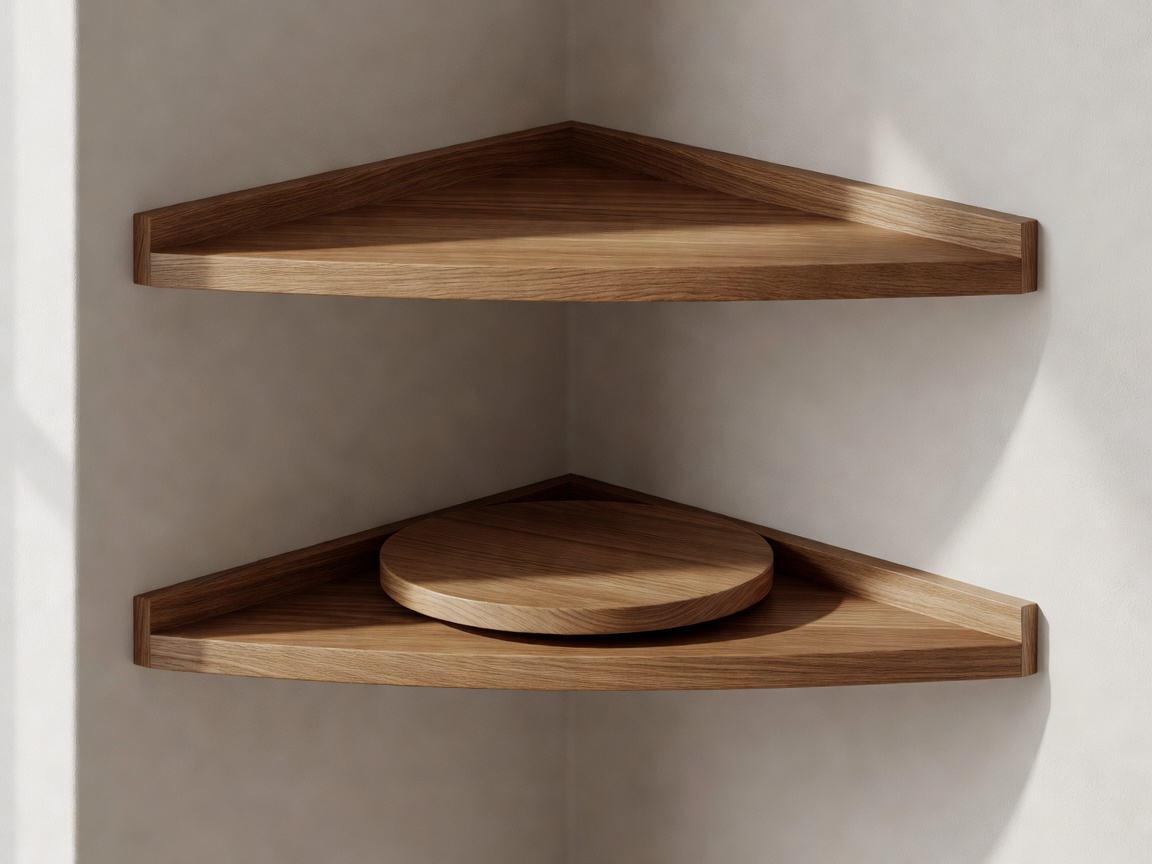
Triangular floating shelf
The classic. Fixed to both walls, it needs no floor space and suits plants, speakers and small decor. It is the only fix in our comparison that always means drilling, so rent-check first.
Tension-pole shelf stack
A spring-loaded pole wedges between floor and ceiling, and shelves clip onto it. No drilling, which makes it a renter's favourite. Check that the ceiling is solid. A crumbling textured ceiling is a poor anchor.
Corner ladder
Two leaning frames hinged at roughly 90°, free-standing. Good for wardrobe corners and living rooms. Tall units can tip, so use an anti-tip strap if there are children or pets.
Wrap-around L shelf
This one is for outside corners. It hugs the protruding edge and turns an obstacle into a display ledge. Measure both faces separately, because walls that look equal rarely are.
Fixings: match the wall, not the shelf
The shelf is only as secure as what holds it. On masonry, use wall plugs from a maker such as Rawlplug or Fischer with screws rated for the load. On plasterboard, find the studs, or use cavity fixings such as spring toggles for light loads only. In older homes with lath and plaster, locate the timber behind the surface or choose a free-standing option. Before drilling, run a combined detector for pipes and cables. It costs little and saves a lot.
When the corner isn't 90°
Plaster bulges, walls lean, and extensions are rarely square. Copy the angle with a sliding bevel or a cardboard template, then compute the front edge as √(a² + b² − 2ab·cosθ). With 30 cm walls at 100°, the front edge is about 46 cm. At 80° it shrinks to about 38.6 cm. The calculator on the home page does it for you.
Product rationale
Why we favour floating triangular shelves for first-time fitters
Two fixing lines forgive small marking errors, and a spirit level shows quickly whether the shelf is true.
Why tension poles suit renters
They leave no holes, they come down in minutes, and the shelves are adjustable if your stuff changes.
Why we avoid glass corner shelves in busy rooms
Edges on glass shelves sit exactly at hip height in a corner. In family spaces, timber or rounded metal is kinder.